Insights
What Is Purpose Bound Money (PBM)?

What if digital money could carry rules for how it is used? Purpose Bound Money (PBM), introduced by the Monetary Authority of Singapore (MAS), starts with that idea. By specifying conditions for the use of funds, PBM offers a new approach to complex payment and funding challenges.
This article explains the concept and explores practical applications.
Understanding Purpose Bound Money
PBM attaches programmable purposes and conditions to digital money. In simple terms, it can specify that funds may be used only for particular purchases or released only when agreed conditions are met. What could that look like in everyday life?
PBM in everyday life

Examples of potential PBM applications
Government relief payments
Consider a relief program intended to support local small businesses. If funds are spent outside the intended merchant network, the program may not achieve its goals. PBM could encode a rule limiting use to eligible neighborhood restaurants and shops, helping enforce the program’s spending conditions at the point of payment.
Prepaid purchases
The failure of online commerce platforms has left consumers exposed after paying in advance. Similar risks arise with gym memberships, wedding venue deposits, and other prepaid services. PBM offers a way to make payment release conditional on delivery.
For example, ticket payments could be released to a concert organizer only when the event takes place. If it is canceled or specified conditions are not met, the funds could be refunded automatically. This approach can support consumer protection and confidence in the service.
Employee benefits
Benefits intended for employees’ health and cultural activities are sometimes converted to cash or used for other purposes. PBM could restrict eligible spending to activities such as gym memberships, books, and performances, helping employers deliver the benefits they intended.
Education funding
Scholarships for tuition and textbooks often require extensive documentation to verify appropriate use. PBM could apply eligibility rules directly, allowing funds to be used only for tuition and designated learning materials while reducing administrative work.
Across these examples, PBM can help align the use of funds with their intended purpose.
Where current systems fall short
Governments, businesses, and universities already distribute funds for specific purposes. Managing those programs, however, can be complex and inefficient.
Limited visibility into spending
Once funds have been distributed, confirming that they were spent as intended can be difficult. A small-business support program, for example, may need substantial staffing and time for retrospective checks.
Complex reconciliation
Employee benefit programs often require administrators to review receipts and supporting documents individually, creating a significant month-end workload.
High administrative costs
Ongoing monitoring, dedicated personnel, and investigations into suspected misuse all consume time and resources.
Friction for users
Recipients may face complicated documentation, long reimbursement waits, and uncertainty about eligible merchants. Finding places that accept a restricted-use card, such as Korea’s Munhwa Nuri culture card, can itself be inconvenient.
These issues make purpose-specific funding harder to manage: providers lack confidence in how funds are used, administrators face excessive paperwork, and recipients encounter unnecessary friction.
What PBM could change
How can PBM address these operational challenges?
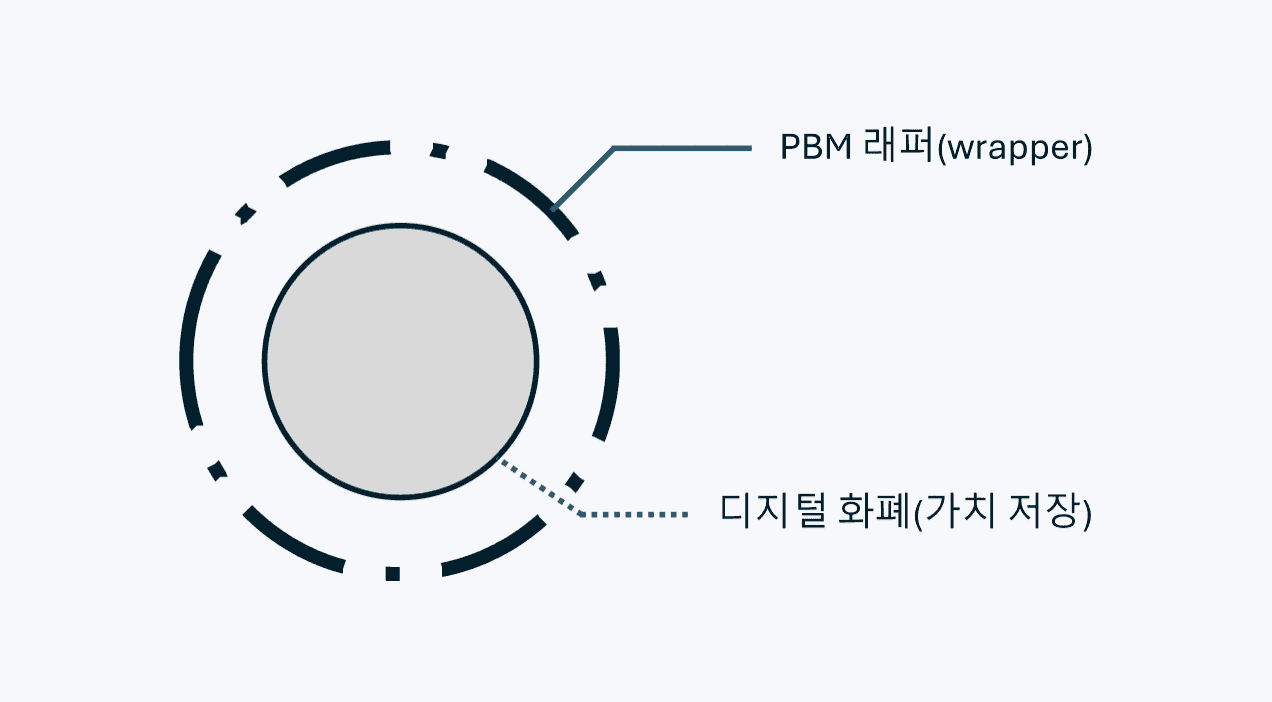
PBM architecture. Source: MAS PBM Technical Whitepaper.
Enforcing spending conditions
Instead of relying entirely on retrospective checks, PBM can apply eligibility rules through smart contracts. Meal support could be limited to approved restaurants, for example, while education funding could be restricted to eligible courses and materials.
More transparent fund management
Blockchain-based transaction records can provide a tamper-resistant view of fund movements, supporting end-to-end traceability.
Donors could gain clearer visibility into how contributions are used. Public agencies could collect transaction data more systematically to assess subsidy programs.
More efficient operations
Reconciliation and supporting records can be automated. When an employee uses benefit points, the system could verify the merchant and amount, complete settlement, and generate the relevant report—reducing manual receipt collection and spreadsheet work.
The benefits extend beyond convenience. Funding providers can apply their intended conditions more consistently, administrators can focus on higher-value work, and recipients can use services with fewer procedural barriers.
The technology behind PBM
What makes these capabilities possible?
Smart contracts: programmable conditions
Smart contracts encode the rules governing when and how funds may be used. Instead of relying solely on a written agreement and manual checks, the system executes those conditions in code, with changes governed by the contract’s defined controls.
Blockchain: a verifiable transaction record
A blockchain distributes transaction records across participating nodes and makes unauthorized changes difficult. Its shared, persistent history supports transparent management and verification of fund movements.
Tokenization: assets with defined properties
Tokenization can represent funds digitally and associate them with specific usage rules. Meal-support and education tokens, for example, can carry different eligibility conditions to support more precise asset management.
SOOHO.IO’s PBM expertise
Reliable implementation requires specialist technology and operational experience. SOOHO.IO brings blockchain and cryptography expertise informed by its participation in central bank CBDC projects.
Its PBM approach starts with the customer’s business context. Support spans smart contract design, token-economy design, implementation, and ongoing operations.
With this experience, SOOHO.IO helps organizations assess and implement PBM securely and effectively.
Explore PBM for your organization
Arrange a PBM consultation with SOOHO.IO.
We will help identify a solution suited to your requirements.
SOOHO.IO Official Channels
Website: https://www.sooho.io/
X (Twitter): https://twitter.com/soohoio
LinkedIn: https://www.linkedin.com/company/sooho/